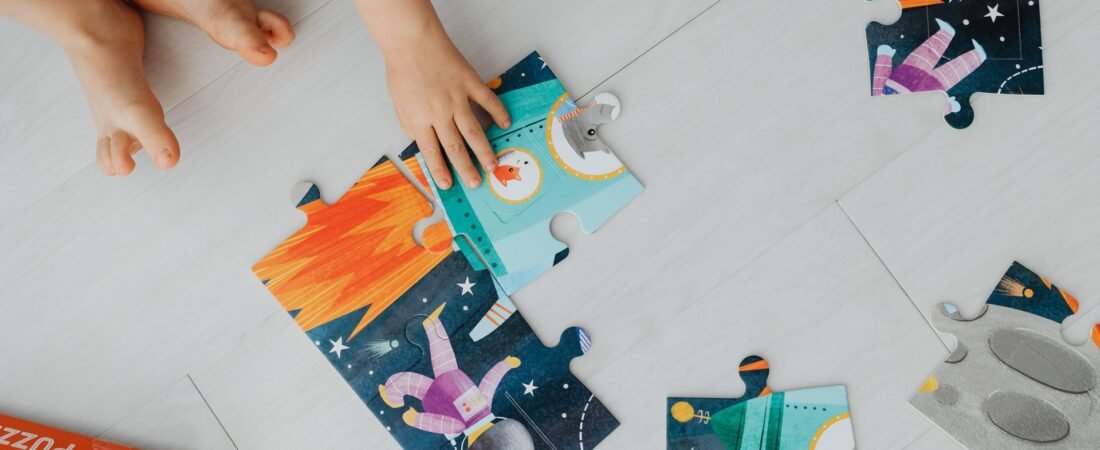
A first puzzle can be a small but exciting discovery for a toddler. Finding the right piece, turning it around and watching it fit into place can provide a wonderful sense of achievement.
The best puzzles for toddlers are simple, sturdy and appropriate for their stage of development. They encourage children to explore shapes, pictures and problem-solving without making the experience too difficult.
Whether your child is just beginning to explore puzzles or is ready for more challenging designs, here’s what to look for when choosing a puzzle for ages 1–3.
Why Are Puzzles Good for Toddlers?
Puzzles offer more than a way to keep little hands busy. Through play, toddlers can practise:
- Problem-solving: Working out where each piece belongs.
- Fine motor skills: Picking up, turning and placing pieces.
- Hand-eye coordination: Matching a piece to its space.
- Visual recognition: Noticing shapes, colours and familiar pictures.
- Patience and persistence: Trying again when a piece doesn’t fit.
Puzzles can also create opportunities for conversation. You can name the pictures, describe colours and ask simple questions while playing together.
6 Types of Puzzles for Toddlers
1. Wooden Peg Puzzles
Wooden peg puzzles are a popular first choice for toddlers. Each piece has a small handle that makes it easier to lift and place.
Choose simple designs with a few large pieces and familiar pictures, such as animals, vehicles or everyday objects. Check that the knobs are securely attached and suitable for your child’s age.
2. Chunky Wooden Puzzles
Chunky puzzles feature thick pieces that toddlers can pick up and explore. Some pieces can also stand independently, allowing children to use them in pretend play.
These puzzles are useful for introducing simple matching and shape recognition.
3. Shape Sorting Puzzles
Shape puzzles invite children to match circles, squares, triangles and other basic shapes with their corresponding spaces.
Start with a small number of clearly different shapes. Gradually introduce more variety as your child becomes confident.
4. Animal and Vehicle Puzzles
Toddlers often enjoy pictures of familiar animals, cars, trains and other everyday subjects.
These puzzles can also support language development. While your child plays, talk about the pictures: “Where is the dog?” or “What sound does the cow make?”
5. Simple Jigsaw Puzzles
As toddlers grow, some may enjoy simple jigsaw puzzles with a few large pieces.
Look for age-appropriate designs with clear pictures and pieces that are easy to handle. Start with only a few pieces rather than a large puzzle.
6. Matching Puzzles
Matching puzzles introduce the idea of finding two pictures or objects that belong together. For example, a puzzle might match an animal with its home or a familiar object with its use.
Choose designs that are easy to understand and don’t rely on very small pieces.
How to Choose Puzzles by Age
Children develop at different speeds, so age ranges should be treated as general guidance rather than strict milestones.
Ages 1–2: First puzzle experiences
Look for large, simple pieces, sturdy construction and familiar images. Wooden peg puzzles and chunky puzzles can be good starting points when the manufacturer recommends them for your child’s age.
Ages 2–3: More matching and problem-solving
Some toddlers are ready for puzzles with more pieces, simple jigsaws and shape-matching activities. Choose a level that offers a little challenge without causing frustration.
If your child loses interest, try an easier puzzle or complete it together.
What to Look for When Buying Toddler Puzzles
Before purchasing, consider these factors:
- Age suitability: Follow the manufacturer’s age recommendation.
- Piece size: Avoid small pieces that could be choking hazards.
- Material: Check that the puzzle is sturdy and made with child-appropriate materials.
- Finish: Look for smooth edges and secure components.
- Design: Choose clear pictures and simple shapes that interest your child.
- Durability: Pieces should withstand regular handling.
- Play value: Consider whether the puzzle offers opportunities for naming, sorting and imaginative play.
For young children, safety matters more than the number of pieces or how attractive a puzzle looks.
How to Introduce Puzzles Without Frustration
A few small changes can make puzzle time more enjoyable:
- Start with a puzzle that has only a few pieces.
- Show your child how to place one piece.
- Name the pictures and describe the shapes.
- Let your toddler try independently.
- Offer gentle encouragement rather than completing everything for them.
- Stop when your child loses interest and try again another day.
Remember, the goal is exploration and enjoyment, not finishing the puzzle as quickly as possible.
Final Thoughts
The best puzzles for toddlers are not necessarily the most complicated or expensive. A simple wooden peg puzzle or a chunky animal puzzle can provide plenty of opportunities to practise coordination, recognition and problem-solving.
Choose something that matches your child’s interests and current abilities. With a little encouragement and plenty of time to explore, puzzle play can become a lovely part of everyday learning.
For further guidance on age-appropriate toy choices and potential hazards, consult the CPSC Toy Safety Guide.
Discover more ideas for playful learning in our Play & Learn collection.