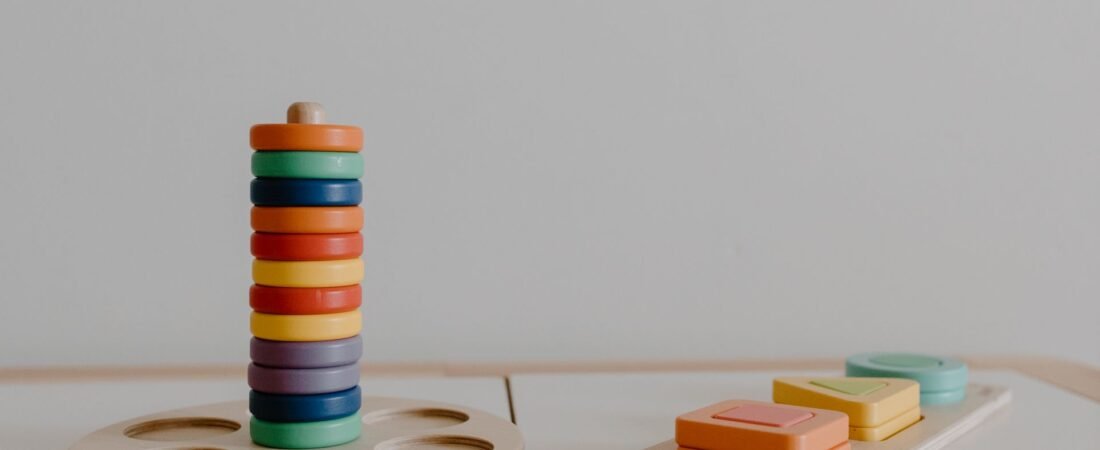
Finding the best educational toys for 2-year-olds can be easier when you know which toys encourage creativity, problem-solving and independent play. There are so many colourful options, but the most meaningful toys are often the simplest ones: objects that invite little hands to explore, experiment, build and imagine.
At this age, children are becoming more independent. They are learning through movement, repetition, imitation and hands-on discovery. The right toys can encourage these skills while keeping play enjoyable and open-ended.
Here are some educational toy ideas worth considering for your two-year-old.
1. Wooden building blocks
Building blocks are a classic for a reason. Toddlers can stack, knock down, arrange and build again. This simple activity encourages hand-eye coordination, spatial awareness and early problem-solving.
Look for: Smooth, sturdy blocks in different shapes and sizes, with non-toxic finishes.
Explore more wooden toys idea at our guide page.
2. Shape sorters
Shape sorters introduce children to basic shapes and the idea of matching. Trying different openings also encourages persistence and problem-solving.
Look for: A simple design with easy-to-hold pieces and openings that are not frustratingly difficult.
3. Stacking toys and nesting cups
Stacking rings, cups and wooden towers help toddlers explore size, balance, order and cause and effect. They can also be used for pretend play and simple sorting games.
Look for: Pieces that are easy to grasp and large enough to avoid choking risks.
4. Chunky puzzles
A simple puzzle gives toddlers an opportunity to recognise shapes, practise hand control and work towards completing a small challenge.
Look for: A few large pieces, sturdy construction and familiar pictures such as animals, vehicles or everyday objects.
Looking for more ideas? Explore our guide to the best puzzle for toddlers in our guide page.
5. Pretend-play sets
Toy kitchens, play food, dolls, animal figures and simple tool sets can inspire imaginative play. Children often enjoy copying everyday activities they see at home.
Look for: Durable, age-appropriate pieces without small detachable parts.
6. Stacking and balancing toys
Balancing stones, large wooden pieces and simple stacking toys encourage experimentation. Children discover what happens when they change the position or order of objects.
Look for: Stable, child-friendly pieces with no sharp edges.
7. Large-piece construction toys
Simple construction toys let toddlers connect, separate and build. These activities support fine motor development and early creative thinking.
Look for: Large pieces designed specifically for the child’s age group.
8. Musical instruments
A small drum, xylophone or shaker can introduce rhythm, sound and creative expression. Making music together is also a lovely way to connect.
Look for: Robust instruments with securely attached parts and a comfortable volume.
9. Picture books and interactive books
Books are wonderful learning companions. Lift-the-flap books, books with textures and simple picture books invite children to point, name objects and enjoy stories together.
Look for: Sturdy pages, clear illustrations and short, engaging text.
More ideas? Check out our guide on picture books for toddlers.
10. Sorting and matching toys
Simple colour-matching or object-sorting activities introduce early classification. Toddlers can group objects by colour, shape or type with an adult’s help.
Look for: Large pieces and a straightforward activity that can be adapted as your child learns.
What makes a good educational toy?
A toy does not need flashing lights or lots of buttons to support learning. Before buying, consider:
- Open-ended play: Can your child use it in different ways?
- Age suitability: Is it designed for your child’s developmental stage?
- Safety: Are the pieces too small, detachable or otherwise unsuitable?
- Durability: Can it withstand repeated everyday play?
- Simplicity: Does it encourage your child to explore rather than simply watch?
A little reminder: play does not need to be complicated
At two years old, children learn through everyday experiences. Stacking blocks, looking at a picture book, pretending to cook or sorting a few safe household objects can all become meaningful moments of discovery.
Choose toys that interest your child, allow plenty of time for exploration and enjoy playing together.
Safety note: Always follow the manufacturer’s age guidance and supervise young children during play. Check toys regularly for loose, broken or damaged parts, and avoid small objects that may present a choking risk. You can find more guidance in the CPSC Toy Safety Guide.
Discover more ideas for playful learning in our Play & Learn collection.